Skip to content

Bot detection inside your app, with written verdicts

Refusing every automated client breaks search indexing and partner webhooks. camada runs as a fail-open middleware inside your backend, joins request headers, a first-party browser beacon and track() outcomes, and has Watchkeeper, camada's AI analyst, review whole sessions every few minutes. Malicious clients go onto an in-memory blocklist your app enforces before handlers run. Customers and verified Googlebot, bingbot and Applebot get through.

Get started freeFour signal layers

Free up to 100,000 events a month, no card. Blocking starts on Starter at $59 a month.

server.js · @camada/node
import camada from '@camada/node';

app.use(camada.express()); // enforces in-memory blocklist, ships redacted events

app.post('/login', async (req, res) => {
  const ok = await verifyPassword(req.body.email, req.body.password);
  if (!ok) camada.track(req, 'login_failed', { user: req.body.email });
  return ok ? res.redirect('/account') : res.status(401).send('Invalid login');
});

Example verdict · Session · ses_7f3a9c1e04b2

Malicious · 91% confidence · Blocked for 6 hours

This session submitted login attempts for many different accounts with one password pattern. The failure rate and pacing match a stolen-credential list being replayed.

  • 38 login attempts for 36 different usernames in 3 minutes
  • 97% of attempts returned an invalid credentials response
  • Requests spaced at near-identical intervals of about 4.7 seconds
  • Login form posted with no prior page view of the form

Why edge gates, rate limiting and CAPTCHAs miss app-layer abuse

Per-IP rate limiting counts volume from one address, so attackers rotate through residential proxies at two requests per IP. Client puzzles add friction to signup and checkout forms while leaving JSON APIs unguarded. Edge bot management scores requests outside your app, before your code checks whether the password worked or the payment failed.

What your app saw across a credential spray. Demo data.
01:14:02POST/api/auth/login401
01:14:07POST/api/auth/login401
01:14:12POST/api/auth/login200
01:20:04POST/api/auth/login403
01:20:09POST/api/auth/signup403

Where it runs

Per-IP rate limiting
Middleware, gateway or Redis counter per IP or route
CAPTCHA / Turnstile
Client widget in HTML forms plus a verification POST
Edge bot management
CDN proxy in front of your origin (DNS move required)
camada in-app SDK
One fail-open SDK inside your backend; your CDN stays as it is

Rotating residential proxies

Per-IP rate limiting
Misses attacks spread across hundreds of clean IPs at 1 to 2 tries each
CAPTCHA / Turnstile
Solvers and human farms pass token checks per session
Edge bot management
Scores each request at the edge without knowing if the login succeeded
camada in-app SDK
Groups sessions, client shapes and TLS fingerprints across IPs over the run window

Headless Playwright and AI scrapers

Per-IP rate limiting
Allows steady catalog scraping that stays just below your threshold
CAPTCHA / Turnstile
Rarely placed on public product or pricing pages because it blocks readers
Edge bot management
Scores per request; Enterprise tiers often required for behavioral models
camada in-app SDK
First-party /_cam/b.js beacon checks webdriver, WebGL, input events and client hints while verified Googlebot gets in

Failed logins and signups per account

Per-IP rate limiting
Cannot tell a 200 login success from a failed password unless you wire custom counters
CAPTCHA / Turnstile
Runs before your auth check; never learns whether the password failed
Edge bot management
Sees HTTP status codes on the wire, not which account was targeted
camada in-app SDK
track() reports login_failed, login_succeeded, signup and payment_failed with account IDs HMAC-hashed in-process

JSON and mobile API routes

Per-IP rate limiting
Counts volume only; throttles busy partner integrations alongside attackers
CAPTCHA / Turnstile
Widget challenges break non-browser API clients
Edge bot management
Enforces at the proxy, often with opaque risk scores and no per-block writeup
camada in-app SDK
Blocks listed IPs and paths with 403 before handlers run; challenge verdicts add x-camada-challenge: 1 on API calls

Setup and published price

Per-IP rate limiting
DIY counters and tuning; no analyst or written verdicts
CAPTCHA / Turnstile
Free tiers capped or branded; conversion drop on signup and checkout forms
Edge bot management
Often gated behind enterprise sales quotes and traffic rerouting
camada in-app SDK
One package and CAMADA_KEY; Free $0 (100k events/mo), Starter $59/mo, Growth $249/mo

Already running Cloudflare, DataDome or rate limits in front of your origin? Keep them. camada sits behind your CDN and evaluates the sessions that still reach your handlers.

Four signal layers, scored across the whole session

Single-request checks struggle when an AI scraper or credential stuffer uses a real browser engine on a clean home IP. camada joins four sources of evidence across the session before deciding.

1. Request wire and network context

On each request, the middleware records method, path, query shape, status, latency, header names and order, client hints and your trusted-proxy-resolved IP. Raw X-Forwarded-For headers are never trusted without your proxy configuration, so spoofed headers cannot poison your blocklist.

Paths and queries are also checked against exploit signatures compiled daily from CISA Known Exploited Vulnerabilities, CrowdSec, Emerging Threats and nuclei. On Cloudflare Workers (@camada/hono and @camada/sveltekit with adapter-cloudflare), request.cf exposes TLS fingerprints, ASN and country for both scoring and in-app enforcement.

Test your browser and TLS signals Decode User-Agent and Client Hints CVE exploit scan detection @camada/hono on Workers

Wire signalWhat it exposes
Header names, sizes and wire orderBrowsers send stable header sets and ordering; HTTP scripts and raw clients rarely match them
Client hints and Sec-Fetch headersA Chrome User-Agent missing Sec-CH-UA hints points to a spoofed header or headless client
CVE and scanner path signaturesRefreshed daily from CISA KEV, CrowdSec, Emerging Threats and nuclei, with a 7-day look-back
Trusted-proxy client IP, ASN and TLSResolves IP safely, reads JA4 on Vercel for scoring, and enforces TLS/ASN/country on Workers

2. First-party headless browser detection (/_cam/b.js)

Your own SDK serves the browser beacon from your origin at /_cam/b.js and receives posts at /_cam/fp, tied to the page view by request ID. Because there is no third-party tracker domain, strict Content Security Policies and ad blockers do not break telemetry.

Headless Playwright and Puppeteer clients give themselves away across a session: navigator.webdriver, automation globals, software WebGL renderers, mismatched User-Agent strings, or HTML pages loaded at scale without executing JavaScript. Real keyboard and pointer input soon after page load lowers a visitor's score so normal customers stay clear.

Run the live headless browser test Check robots.txt and AI crawler rules Web and AI scraper detection Rogue AI agent protection

Express · first-party beacon
import camada from '@camada/node';

app.get('/signup', (req, res) => {
  res.type('html').send(`<!doctype html>
<html>
  <head>${camada.scriptTag(req)}</head>
  <body>...</body>
</html>`);
});

Example verdict · Session · ses_c20e6d8f19a5

Suspicious · 64% confidence · Challenge recommended for 2 hours

This session completed a sign-up form faster than a person could type it. The interaction timing was uniform from the first field to the submit.

  • Form submitted 1.1 seconds after page load
  • No key presses or pointer moves recorded before submit
  • Browser reported properties typical of a headless client

3. App-context truth via track()

An edge proxy sees POST /login; only your handler knows whether the password failed, which account it targeted, or whether a trial signup burned credits. One track() call attaches that outcome to the current request and session.

Account identifiers you pass to track() are HMAC-hashed inside your process using your ingest token before queuing. Raw emails and user IDs never leave your server, yet Watchkeeper can still count failed logins across accounts to catch password sprays and flag any account an attacker managed to open.

Credential stuffing and account takeover

Event nameWhen your handler records it
login_failed / login_succeededa credential check settled
signupan account was created
password_reseta reset was requested
mfa_faileda second factor was rejected
payment_failed / payment_succeededa charge settled
coupon_faileda promo code was rejected

4. Off-path AI investigation and in-memory enforcement

Every 10 minutes by default (5 minutes at the fastest), camada aggregates each project's new events by IP, session and TLS fingerprint and scores them against 80 behavioral rules. 8 trust rules lower the score for verified search crawlers and real browser interaction.

Borderline clients go to a triage model 15 at a time, and the highest scorers go to Watchkeeper's investigation agent (up to 10 clients per run, at most 3 tool rounds) to write a verdict with its supporting requests. By default, blocking requires a malicious verdict at 80% confidence or higher, and Watchkeeper never blocks on a User-Agent string alone.

Your SDK polls the resulting blocklist snapshot every 30 seconds with an ETag (304 when unchanged) and blocks listed clients in memory with a 403 before your route runs. For challenge verdicts, browsers receive a self-contained 16-bit SHA-256 proof-of-work page (_cch HttpOnly cookie), while API routes receive an x-camada-challenge: 1 header.

Full scoring and investigation pipeline SHA-256 proof-of-work challenge

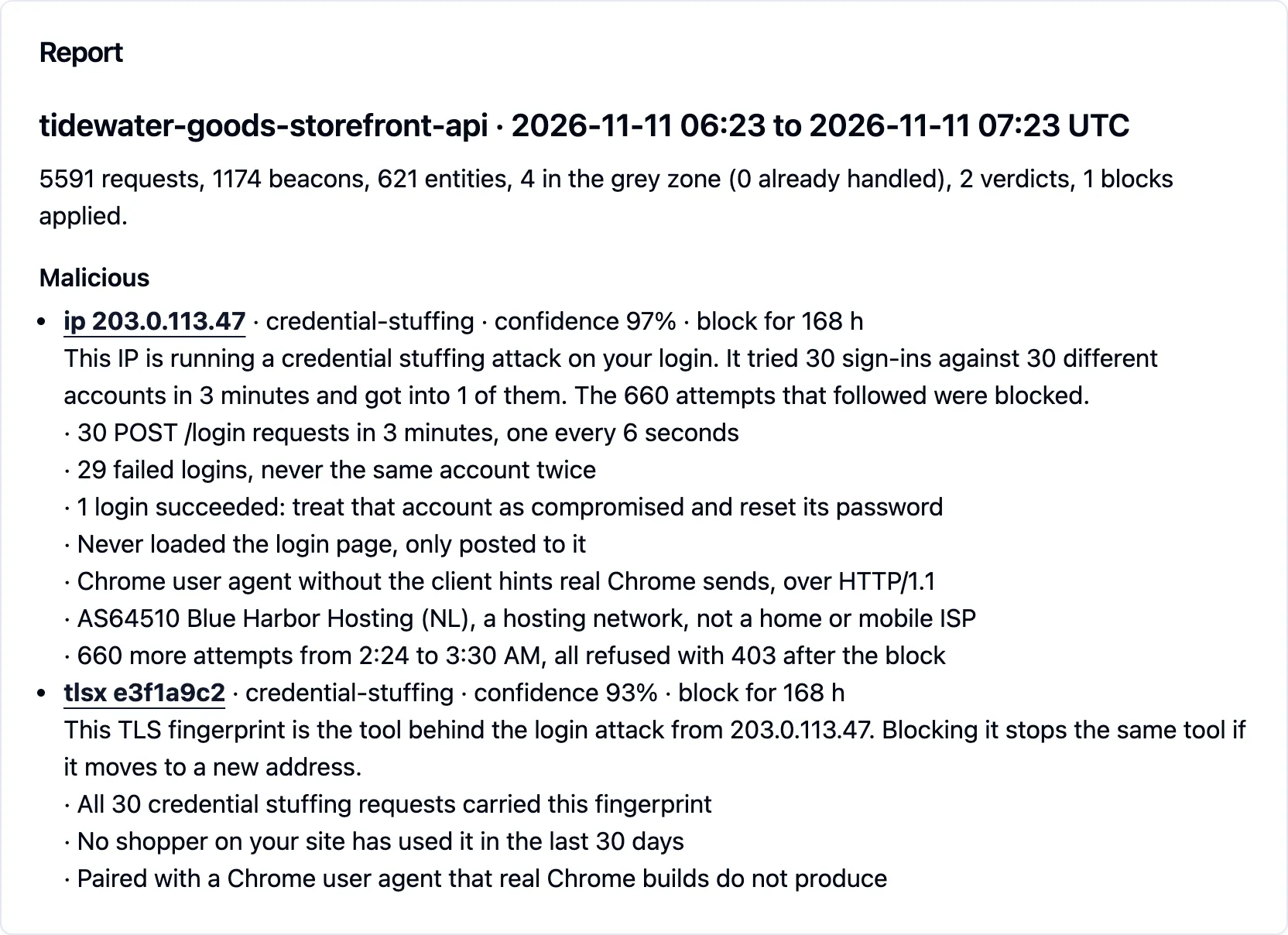
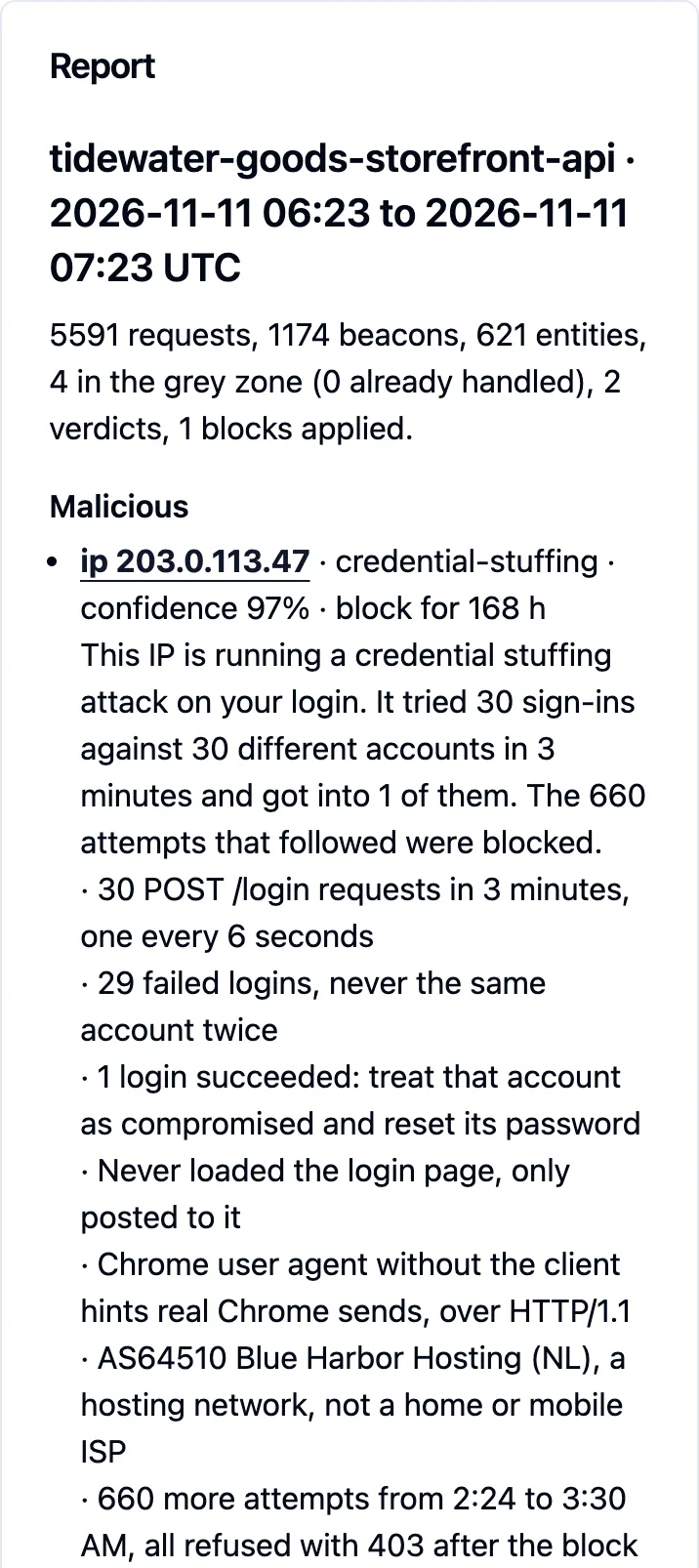
Watchkeeper's written report in the camada app showing sign-in totals, failures, and why the client did not behave like a real browser.
Watchkeeper's written run report, with the evidence behind the verdict. Demo data.
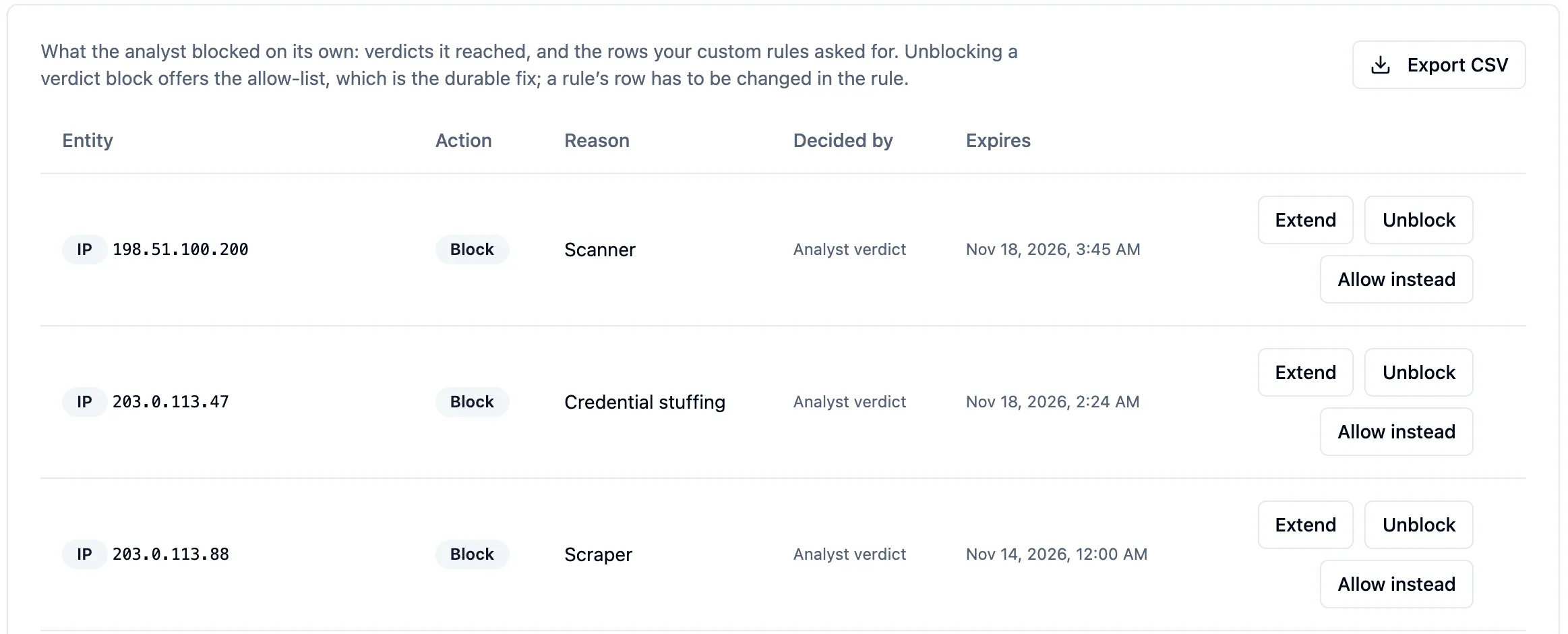
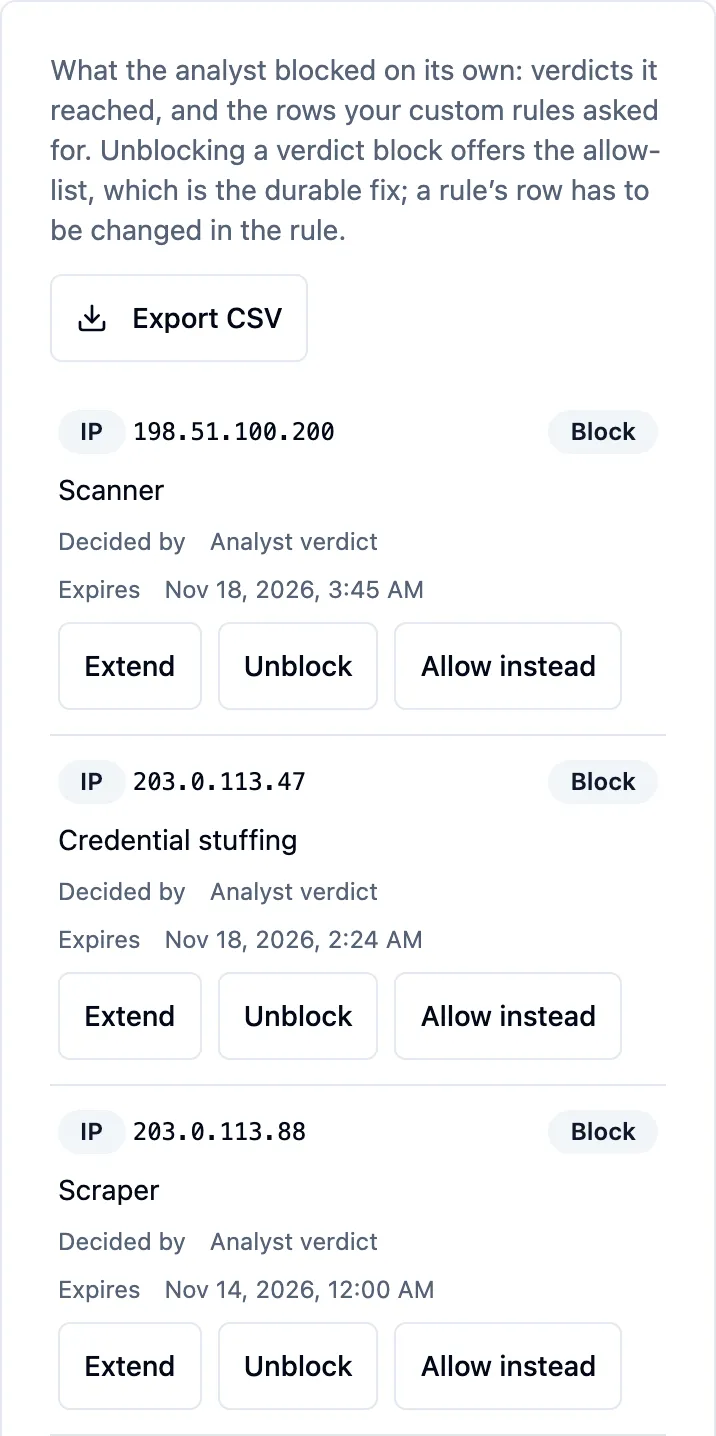
The camada app blocklist listing blocked addresses, written reasons, expiry times and controls to unblock or allow instead.
The active blocklist in the app, synced to your SDK every 30 seconds. Demo data.

Drop-in bot detection middleware for your stack

Install one package, mount the middleware ahead of your routes, and set CAMADA_KEY in your process environment. Every SDK is open source under the MIT license on GitHub.

Next.js (App Router)

Edge-safe middleware enforces the blocklist, serves the beacon first-party through a route handler, and forwards Vercel JA4 TLS digests for scoring.

Next.js quickstart

Next.js · @camada/next
npm i @camada/next

// middleware.ts (Next ≤15) or proxy.ts (Next 16) at the project root
import { camada } from '@camada/next';
export default camada();
export const config = { matcher: ['/((?!_next/|favicon.ico).*)'] };

// app/api/camada/[...camada]/route.ts
import { camadaRoute } from '@camada/next';
export const { GET, POST } = camadaRoute();

// app/layout.tsx, inside <head>
import { CamadaBeacon } from '@camada/next';
<CamadaBeacon />

// in a server action or route handler when sign-in fails
import { track } from '@camada/next';
await track('login_failed', { user: email });

Express and Node.js

Captures response status, latency and true wire header order on response finish. Adapters ship in the same package for Express, Fastify, NestJS and Koa.

Express quickstart

Express · @camada/node
npm i @camada/node

import camada from '@camada/node';
app.use(camada.express());

// inside your signup or checkout handler
camada.track(req, 'signup', { user: email });

FastAPI, Django and Flask

Pure ASGI middleware keeps wire header order and streaming responses intact, while Django and Flask integrations cover sync and WSGI stacks.

Python SDK reference

FastAPI · camada
pip install camada

from camada.fastapi import CamadaMiddleware
app.add_middleware(CamadaMiddleware)   # any Starlette app too

# inside an endpoint once a credential check settles
from camada.fastapi import track
track(request, "login_failed", user=email)

Language SDK references and all 14 framework quickstarts

PHP, Java and .NET install from GitHub until they are published on Packagist, Maven Central and NuGet. Every runtime reads CAMADA_KEY from the process environment.

Cloudflare, no code
camada-cloudflare
Hono on Workers
@camada/hono
Python
camada
Go SDK
github.com/camada-app/camada-go
PHP
camada/camada
Ruby
camada
Java
dev.camada:camada
.NET
Camada

Framework quickstarts: Express · Fastify · NestJS · Koa · Next.js · FastAPI · Django · Flask · Go quickstart · Rails · PHP · Laravel · Spring Boot · ASP.NET Core.

Compare all 14 framework positions Full documentation index

Honest limits before you install

Developers distrust security tools that claim to stop everything. Here is what in-app bot detection does and where its boundaries sit.

First requests reach your app before a block applies.
Watchkeeper reviews traffic every 10 minutes by default (5 minutes at the fastest), after your app has answered. A new attacker's first requests get responses until the run writes a verdict and your SDK pulls the updated snapshot. A one-shot exploit on request one is not stopped.
How the analysis window works Exploit watch
Not a WAF, DDoS service or code patch.
Request and response bodies, cookies and Authorization header values never leave your process. camada cannot match payloads carried only inside a POST body, absorb volumetric DDoS floods upstream, or patch a vulnerable dependency.
Data redaction and security
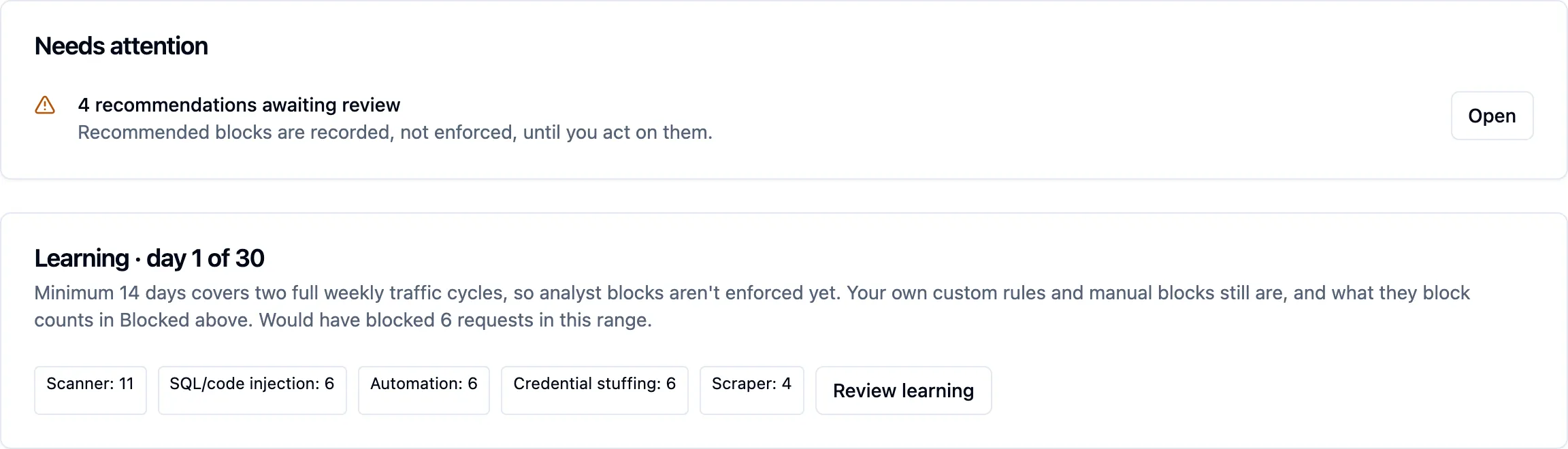
New projects start in a recommend-only learning window.
Nothing is blocked when you first install. Watchkeeper scores your traffic and lists what it would block, with the evidence requests attached, until a person on your team turns enforcement on.
Every SDK fails open on outages and cold starts.
No model sits on your request path. If camada is unreachable or an SDK call throws, your handler runs normally and never returns a 5xx because of camada. Cold serverless instances pass their first request while loading the snapshot, and CAMADA_DISABLED=1 switches the SDK off per request.
Fail-open guarantees
Enforcement keys depend on where the SDK sits.
The in-app SDKs for Node, Next.js, Python, Go, PHP, Ruby, Java and .NET enforce IP, path, user-agent and header conditions, and fail open on ASN, country and TLS-fingerprint entries. In-app TLS, ASN and country enforcement runs on Cloudflare Workers with @camada/hono or @camada/sveltekit on adapter-cloudflare.
Rules and list entries @camada/hono on Workers
Challenges apply to browser page loads, not API clients.
When a verdict calls for a challenge, your SDK serves a self-contained SHA-256 proof-of-work page to browsers and sets an HttpOnly _cch cookie for one hour. Non-HTML fetch and API calls pass through to your handler with an x-camada-challenge: 1 response header.
How proof-of-work challenges work
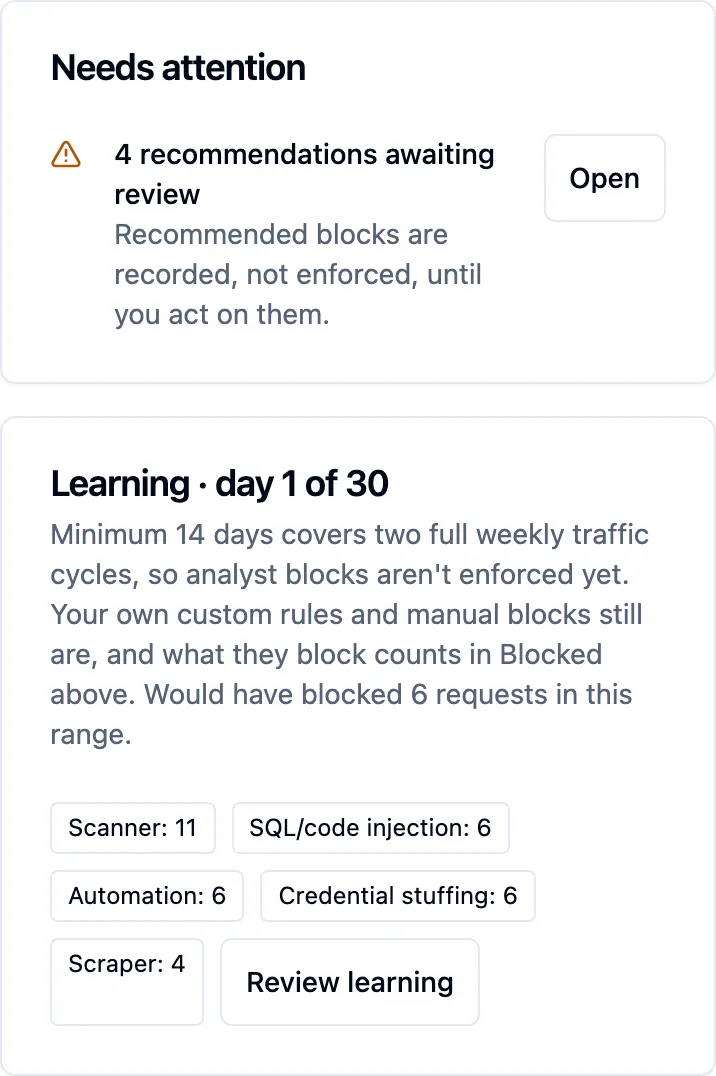
The camada app during the initial learning window: recommended blocks recorded for review with zero requests enforced yet.
Every new project starts in a recommend-only learning window. Nothing is blocked until you turn enforcement on. Demo data.

Attack guides: Credential stuffing · Web and AI scraping · AI agent abuse · CVE exploit scans. Vendor comparisons: DataDome · Kasada · HUMAN Security · Cloudflare · Arcjet. Free browser tools: All developer tools · Bot signal test · User-Agent checker · Access log analyzer · Login page check · robots.txt checker · CSP header analyzer. Terms and architecture: Security glossary · About camada.

Frequently asked questions

Plain answers on crawler verification, request-path latency, headless browsers, proof-of-work challenges and pricing.

Full plan comparison SDK docs

How does bot detection keep bad actors out without hurting search crawlers?
camada judges clients by behavior across a session rather than by User-Agent string alone. Googlebot, bingbot and Applebot are verified against the IP ranges those companies publish, and verified crawlers score lower so they keep indexing your site. Clients that fake a crawler name from outside those ranges get flagged, and your allow-list keeps partner integrations untouched.
Does camada add latency or put an AI model on my request path?
No model sits on your request path. Each incoming request checks an in-memory blocklist snapshot that your SDK polls every 30 seconds with an ETag, where an unchanged list costs a 304. Request events are redacted and shipped in batches after the response, and every SDK call fails open if camada is unreachable.
How does camada detect headless browsers like Playwright and Puppeteer?
Your SDK serves a first-party browser beacon from your own origin at /_cam/b.js, so ad blockers and strict CSP rules do not strip third-party scripts. The beacon reports navigator.webdriver, automation globals, software WebGL renderers, screen and timezone signals, and keyboard or pointer input counts, which Watchkeeper combines with server header order and Sec-CH-UA client hints.
Can I use camada instead of reCAPTCHA or Cloudflare Turnstile?
For most traffic, yes, with an important timing difference. Instead of showing widgets on your login or signup form, camada scores sessions passively in the background and blocks repeat bad actors on later requests. For borderline browser sessions, your SDK can serve a first-party 16-bit SHA-256 proof-of-work page with zero puzzles and no third-party scripts. Because Watchkeeper reviews traffic every few minutes, a brand-new client still gets its first requests answered before enforcement starts.
Why is per-IP rate limiting not enough for AI scrapers and account takeover?
Attackers route credential stuffing and scraping through residential proxy pools where each IP sends only one or two requests, staying below per-IP rate limits and per-account lockouts. camada links requests by first-party session cookie, client header shape, TLS fingerprint where visible, and hashed account outcomes from track(), catching distributed password sprays and catalog scrapers across addresses.
What does camada cost to start?
The Free plan is $0 for up to 100,000 events a month on one project with 7-day retention, email alerts and full Watchkeeper verdicts in recommend-only mode, with no card required. Blocking and challenges start on Starter at $59 a month (1,000,000 events, 3 projects, Slack alerts), and Growth is $249 a month (10,000,000 events, signed webhooks, chat assistant). A 14-day trial of Starter or Growth needs a card.
See what is hitting your app before you block a single request.

Install the SDK on the Free plan and let Watchkeeper score up to 100,000 events a month on one project, no card required. Turn on in-app blocking and proof-of-work challenges on Starter ($59/month) or Growth ($249/month).

Free needs no card. A 14-day trial of Starter or Growth needs a card. Nothing is charged today. Cancel before the trial ends (the date is shown in the app) and you pay nothing. Otherwise the plan's monthly price starts on day 15.